Precast Concrete Manufacturing Equipment: The Complete 2026 Buyer’s Guide
Global construction is shifting fast toward off-site, industrialized building methods — and at the center of that shift sits one thing: оборудование для производства сборного железобетона. From wall panel extruders to hollow-core slab lines, this machinery is what turns raw cement, sand, and steel into the precision-engineered building components that modern contractors demand.
If you’re evaluating a precast concrete production line, comparing suppliers, or simply trying to understand how a precast concrete batching plant fits into a profitable factory setup, this guide covers everything: equipment types, how the process works, what to look for in a supplier, and the real-world ROI you can expect.
What Is Precast Concrete Manufacturing Equipment?
Precast concrete manufacturing equipment refers to the full range of machines used to produce concrete building components — walls, slabs, columns, beams, and blocks — in a controlled factory environment rather than on a live construction site. Components are cast, vibrated, cured, and demolded under consistent conditions, then transported to the job site for rapid installation.
Because quality control happens in the plant instead of in the field, precast construction consistently delivers:
- Faster project timelines (up to 3–5x faster than cast-in-place methods)
- Lower labor costs and reduced dependency on skilled on-site crews
- Tighter dimensional accuracy and stronger, denser concrete
- Less material waste and lower long-term maintenance costs
Why Demand for Precast Concrete Equipment Is Growing
Several trends are pushing contractors, developers, and new factory owners to invest in precast concrete plant equipment:
- Urbanization and housing shortages in Africa, Southeast Asia, the Middle East, and Latin America are driving demand for fast, affordable housing solutions.
- Labor shortages in construction are pushing developers toward automated, less labor-intensive production methods.
- Sustainability pressure — precast reduces on-site waste, dust, and emissions compared to traditional pouring.
- Infrastructure investment in roads, boundary walls, drainage, and utility structures is expanding the addressable market for precast machinery.
Main Types of Precast Concrete Manufacturing Equipment
A complete precast factory typically combines several categories of machines. Here’s a breakdown of the core оборудование для сборного железобетона every buyer should understand.
1. Concrete Batching and Mixing Plants
The batching plant is the heart of any precast concrete production line. It automatically measures and proportions cement, aggregate, water, and additives, ensuring every batch meets exact strength and consistency specifications — critical for reducing waste and controlling production costs.
2. Precast Wall Panel Machines (Extruders)
A машина для производства стеновых панелей из сборного железобетона extrudes hollow-core or solid lightweight panels used for partition walls, boundary walls, and prefabricated housing. Modern extruders support multiple panel thicknesses and can run with foaming agents to produce lightweight foam concrete panels as light as 600 kg/m³ — ideal for markets prioritizing low-cost, fast-build housing.
3. Hollow Core Slab Machines
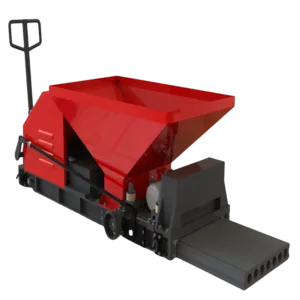
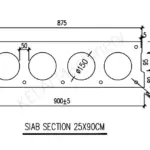
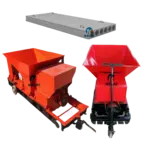
Машины для производства пустотелых плит (also called concrete floor slab machines) produce prestressed floor and roof slabs at 3–5x the speed of traditional formwork methods, while saving 30–50 kg of cement per cubic meter. Two common designs dominate the market:
- Push-type extruders – continuously extrude slabs along a steel casting bed
- Mold-type machines – use fixed molds to shape slabs of specific dimensions
4. Concrete Column and Beam Machines
Used for producing structural columns, beams, and lintels, these machines are essential for building frameworks, fencing, farm structures, and highway boundary walls. High-precision column machines reduce reliance on manual formwork and speed up structural assembly on-site.
5. Prestressed Steel Wire Tensioning Machines
Hydraulic tensioning machines apply controlled prestress force to steel strands before casting, ensuring uniform stress distribution across hollow-core slabs, wall panels, and beams. This step is what gives prestressed precast elements their superior load-bearing strength and long-term durability.
6. Curing Systems
Steam curing chambers or accelerated curing systems shorten demolding time and increase daily production capacity — a key factor for factories aiming to maximize output per shift.
7. Wall Panel Lifting and Installation Machines
Once panels leave the factory, hydraulic lifting machines handle safe, precise on-site installation — replacing multi-worker crews and cranes, cutting installation time by 2–4x, and protecting panels from breakage during placement.
8. Molds, Formwork, and Pallet Systems
Durable steel molds determine the final shape, texture, and dimensional accuracy of precast products. High-wear-resistant alloy molds extend equipment lifespan under 24/7 industrial production conditions.
The Precast Concrete Production Process, Step by Step
- Mix design & batching – raw materials are proportioned in the batching plant
- Pouring – a trolley or conveyor delivers concrete mix into the forming machine
- Extrusion or molding & compaction – vibration removes air bubbles and compacts the mix
- Prestressing (optional) – steel wires are tensioned for structural strength
- Резка – products are cut to required length
- Вылечить – concrete solidifies under controlled temperature and humidity
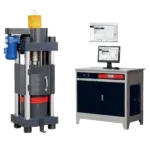
- Demolding & quality inspection – finished components are checked for dimensional accuracy
- Transport & installation – panels, slabs, and columns are shipped and installed with lifting equipment
Key Features to Look for When Buying Precast Concrete Equipment
Not all machinery is built equal. When comparing suppliers of оборудование для производства сборного железобетона, evaluate:
- Уровень автоматизации – higher automation lowers labor costs but requires more upfront investment
- Параметры настройки – can the equipment be configured for your target panel thickness, slab length, or output capacity?
- Build quality – look for high-wear-resistant alloys and industrial-grade hydraulics rated for continuous operation
- Energy efficiency – lower power consumption directly improves your cost-per-unit
- After-sales support – installation training, spare parts availability, and technical response time matter as much as the machine itself
- Local market fit – semi-automatic lines (200–500 m²/day) are often the better ROI choice for markets with limited electricity infrastructure, such as parts of Africa and Southeast Asia
Benefits of Investing in Precast Concrete Manufacturing Equipment
| Выгода | Impact |
|---|---|
| Faster construction cycles | Projects complete 30–60% faster than cast-in-place methods |
| Lower cement consumption | Save 30–50 kg of cement per cubic meter with slab machines |
| Reduced labor dependency | Fewer skilled workers needed on-site |
| Higher product consistency | Tighter tolerances on size, strength, and finish |
| Lower long-term costs | Reduced material waste and maintenance over the product lifecycle |
Applications Across Global Construction Markets
Precast concrete equipment supports a wide range of projects:
- Residential and affordable housing developments
- Industrial facilities and warehouses
- Boundary walls, fencing, and farm structures
- Roads, highways, and infrastructure megaprojects
- Commercial partitions and soundproof industrial walls
These solutions are seeing particularly fast adoption across Africa, Southeast Asia, the Middle East, and Latin America, where the combination of infrastructure gaps and urban housing demand makes fast, economical precast construction especially valuable.
How to Choose the Right Precast Concrete Machinery Manufacturer
Sourcing a precast concrete machinery manufacturer in China — the world’s largest hub for this equipment — comes with real advantages: competitive pricing, mature supply chains, and manufacturers with decades of export experience. When evaluating suppliers, ask:
- How many years of manufacturing and export experience do they have?
- Can they provide references or case studies from your target region?
- Do they offer turnkey solutions — design, installation, training, and after-sales support?
- Can equipment be customized to your production capacity and local material availability?
- What is their typical delivery timeline and warranty coverage?
Emerging Trends in Precast Concrete Equipment (2026 and Beyond)
- AI and IoT integration for predictive maintenance and smarter production monitoring
- Модульная конструкция машины, allowing factories to switch between slab types quickly and minimize downtime
- New material adaptation, including lightweight foam concrete and fiber-reinforced composites
- Greater automation to offset rising labor costs in emerging construction markets
Frequently Asked Questions
What is precast concrete manufacturing equipment used for? It’s used to produce concrete building components — wall panels, floor slabs, columns, beams, and blocks — in a factory setting before transporting them to a construction site for assembly.
How much does a precast concrete production line cost? Costs vary widely based on automation level, output capacity, and equipment type — from semi-automatic single machines to full turnkey production lines. Request a customized quote based on your target daily output and budget.
What’s the difference between a hollow core slab machine and a wall panel machine? Hollow core slab machines produce floor and roof slabs, typically prestressed for load-bearing strength. Wall panel machines extrude non-load-bearing partition or boundary wall panels, often using lightweight foam concrete.
Is precast concrete equipment suitable for small or medium factories? Yes. Semi-automatic lines with daily outputs of 200–500 m² are widely used by small and medium factories, especially in regions with limited electricity infrastructure.
Why buy precast concrete machinery from a Chinese manufacturer? China-based manufacturers typically offer mature technology, competitive pricing, flexible customization, and extensive export experience serving global markets — making them a strong choice for cost-conscious factory setups.
Ready to Set Up Your Precast Concrete Production Line?
With more than 10 years of manufacturing and export experience, Henan Kelai Industrial Co., Ltd. (KELAI®) designs and builds a complete range of оборудование для производства сборного железобетона — from wall panel machines and hollow core slab lines to column machines and prestressing systems — trusted by contractors across Africa, Southeast Asia, the Middle East, and Latin America.
👉 [Contact our team] for a customized equipment recommendation, technical specifications, and a quote tailored to your production goals — or reach us directly via WhatsApp: +86 17788171295.