
Ev / Haberler & İçgörüler / Hollow Core Slab Production Line Equipment
Hollow Core Slab Production Line Equipment: Extruder, Molding Machine and Prestressing Guide
KELAI builds two hollow core slab forming machines, a semi-automated extruder and an inner vibration pulling-mould molding machine, and supports prestressed tensioning on the line. Here is how each piece works, how they fit together, and what to settle before you ask for a quote.
By KELAI Precast Machinery · · 9 min read
Doğru seçimi yapmak hollow core slab production line equipment decides how consistent, fast and profitable your plant will be. Hollow core slabs show up in apartment blocks, offices, warehouses and parking structures for a simple reason: the voids take out concrete and dead weight, and the slab still carries a useful floor or roof span.
Making them consistently depends on the forming machine and on the equipment around it. Below we go through the equipment KELAI supplies, explain how our two forming machines produce slabs, where prestressed tensioning fits in, and list what to decide before you plan a new factory.
1. Two ways to form hollow core slabs
A hollow core slab has continuous voids running along its length. KELAI makes two machines that form them, and they work quite differently.
| Precast concrete hollow core slab extruder | Beton içi boş çekirdek levha kalıplama makinesi | |
|---|---|---|
| Method | Screw-auger extrusion plus high-frequency vibration | Inner vibration with a pulling mould |
| Operation | Semi-automated; travels on a track at constant speed | Winch drive; pulls the mold out after each slab |
| Beton | Dry-mix, low water-cement ratio | Poured into the mold frame |
| Output style | Continuous, long slab blank cut to length | One slab per cycle, then the next |
| Prestressing | Runs along a long bed with tensioned steel wire | Supports prestressed tensioning |
| Strengths | High-efficiency continuous production for standardized mass output | Low cost, simple structure, easy to operate and maintain |
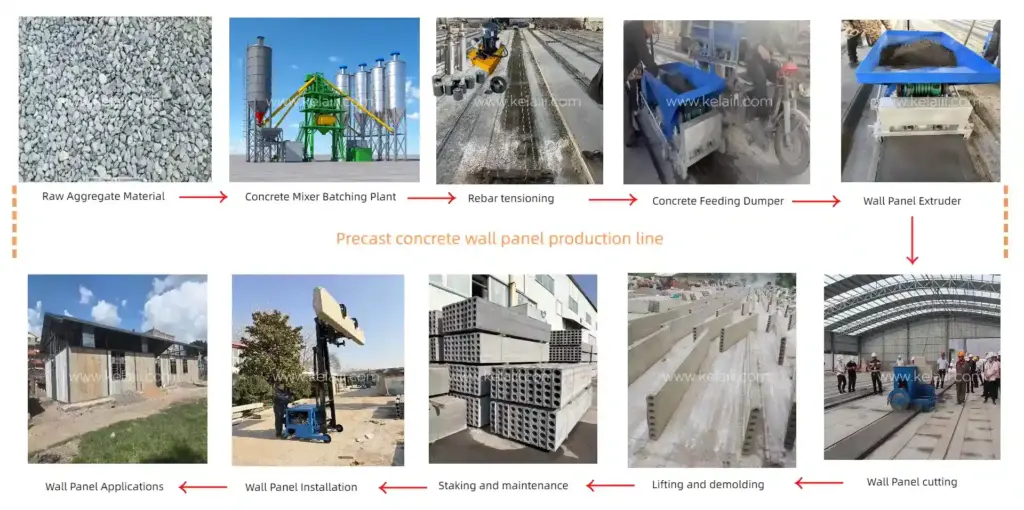
Whichever you choose, the rest of the plant (mixing, cutting, curing, testing and handling) has to be sized to suit it.
2. Hollow Core Slab Production Line Equipment, piece by piece
| Equipment | What it does | Check before you buy |
|---|---|---|
| Batching and mixing plant | Delivers a consistent mix | Output per hour, mixing uniformity, match to the forming machine |
| Prestressing equipment | Tensions steel wire along the bed and releases it | Max force, wire diameter, anchorage, measurement accuracy |
| Hollow core slab extruder | Extrudes, compacts and forms the slab continuously | Slab range, core profiles, mix tolerance, travel speed |
| Hollow core slab molding machine | Forms slabs by inner vibration and mold pulling | Thickness, width and length range, number of vibration tubes |
| Cutting machine | Cuts slabs to length | Max slab size, tolerance, blade wear, dust and slurry handling |
| Curing and testing | Brings concrete to target strength | Steam or natural curing, strength testing |
| Lifting and handling | Moves slabs out and stacks them | Slab weight, lifting points, crane coverage |
| Casting bed and abutments | Carries the prestressing load | Engineering for your force and bed length |
2.1 Concrete batching and mixing
The extruder is fed with dry-mix concrete, so a consistent mix matters more than a high headline capacity. If the mix drifts, the slab shows it: weak compaction, honeycombing or surface voids. The molding machine also depends on steady concrete supply to keep its cycle moving.
A typical setup includes aggregate bins and feeders, cement silos with conveying, weighing equipment, the mixer, a water dosing system and the controls that tie them together. Size it from the concrete your forming machine consumes per hour. A beton karıştırıcı harmanlama tesisi matched to the line keeps the machine from waiting for concrete. To move concrete from the mixer to the forming machine, KELAI also offers an elektrikli beton besleme damper.
Our China site also lists matching concrete batching plants if you want to compare configurations.
2.2 Prestressing and tensioning equipment
KELAI lines support the prestressed tensioning process. Steel wire is laid along the casting bed and pulled to the design force before concrete goes in. The force is transferred to the concrete only after it reaches release strength, which is what lets a slab carry a long span with a modest thickness.
The tensioning side normally includes hydraulic jacks, a hydraulic power unit, force and elongation measuring instruments, anchorage hardware and end abutments, and gear for feeding and handling the steel.
KELAI makes this equipment as well: see the hidrolik çelik tel gerdirme makinesi ve ön gerilimli çelik tel gerdirme makinesi. The range is also shown on our China site. When you review any tensioning system, confirm the maximum force, the wire diameters it accepts, the anchoring method and how accurately force is measured.
One thing to confirm early: settle your steel specification first, then check that the jacks, anchors and abutments were designed for it. Tensioning gear that does not match the steel is a common cause of delays.
2.3 Precast concrete hollow core slab extruder machine
The extruder is a semi-automated machine for continuous production. It combines extrusion molding with vibration compaction, and it forms the slab cross-section directly through mold design, including hollow cavities and ribs, so there is little post-processing. Because it needs no formwork, a single pass can produce slabs up to tens of meters long, which suits standardized mass production.
Its core components are:
- Hopper: holds the dry-mix raw material with a low water-cement ratio.
- Screw feeding system (auger): rotates to transport and compact the concrete into the molding chamber.
- Molding system (molding chamber): a shaped cavity that forms the slab profile, such as hollow cavities and ribs.
- Vibration system: high-frequency vibrators remove air bubbles and raise compaction density.
- Travel system: drives the machine along a track at constant speed for continuous production.
On a prestressed line, the extruder travels along the tensioned bed and compacts the concrete around the steel wire. A good prekast beton levha ekstruder makinesi gives even compaction, clean core walls and a stable slab dimension from the first meter to the last. For more detail, see our hollow core slab machine manufacturer page, the prekast beton döşeme maki̇nasi page, or the hollow core slab machine page on KELAI China.
Why dry-mix matters: the low water-cement ratio lets the slab hold its shape as soon as it leaves the mold, which is what makes continuous extrusion possible.
2.4 Concrete hollow core slab molding machine (inner vibration, pulling mould)
This machine was developed and improved from traditional manual and ground-anchor pull-die mold equipment. It has two main parts: a driving system (winch) and a hollow core slab mold frame. Inside the mold frame sit 6 to 7 vibration tubes, each with a vibrating core connected to a vibrating motor.
After concrete is poured into the mold, the motors spin the vibrating cores at high speed, producing a strong, uniform internal eccentric vibration force that compacts the concrete from the inside. When the slab has formed, the winch pulls the mold out and the next production cycle begins.
| Main technical details | Range |
|---|---|
| Levha kalınlığı | 120 to 300 mm |
| Slab width | 600, 900 or 1200 mm |
| Slab length or span | 6000 to 7500 mm |
You can see the machine on the beton içi boş çekirdek levha kalıplama makinesi page. The benefits are low cost, a traditional and simple structure that is easy to operate, and reliable quality that is easy to maintain. It is a practical choice when you want proven technology without a high investment.
2.5 Cutting machine
Once the slab has set enough, it is cut to the lengths on your production drawings. With the extruder, the continuous slab blank is segmented by an automatic or manual cutter after initial setting. Look at the largest slab section the saw can handle, cutting speed, length tolerance, blade wear and cooling, and how dust and slurry are managed. A comparable precast panel cutting machine is listed on our China site. Clean cuts also protect slab edges during lifting.
2.6 Curing, release and strength checks
Formed slabs are cured by steam curing or natural curing until they reach the target strength. On a prestressed line, the tension is released only once the concrete has reached the specified release strength, so curing speed directly sets how fast the bed turns around. Plan for a fixed curing schedule, protection against moisture loss, and testing of cubes or cylinders before slabs are moved. An automatic compression testing machine in the plant lab makes this check quick and removes guesswork. A matching fully automatic compression testing machine is also on the China site.
2.7 Lifting, handling and transport
Finished slabs are heavy and long, so they need proper lifting gear: overhead cranes, lifting beams or slab clamps, forklifts, and transport to the yard or truck. Work out slab weight, lifting points, travel distance and storage space. The aim is fewer moves and no cracked or chipped edges on the way to the stack.
2.8 Casting bed and support systems
The bed is the foundation of a prestressed line. It carries the prestressing force, so the bed and its end abutments need real engineering for your force, bed length and wire layout. Beyond the bed, the line needs rails and alignment parts, hydraulic and electrical control cabinets, a stock of spares and tools, and material storage with internal transport.
2.9 What the slabs are used for
Hollow core slabs, hollow core wall panels, truss-reinforced slabs and composite slabs are all common products for this kind of equipment. They are widely used in prefabricated buildings for their efficiency, cost-effectiveness and consistent quality.
3. How a production run goes
With the extruder on a prestressed bed
- Prepare the bed and tension the steelCheck the bed, rails and abutments, lay out the steel wire and tension it to the design force.
- Feed and extrudeDry-mix concrete goes from the hopper into the screw augers. The rotating augers push and compact it forward into the molding chamber, which shapes the slab profile.
- Titreşimli sıkıştırmaHigh-frequency vibrators run during extrusion. They rearrange particles, expel air and raise density and strength, preventing honeycombing and surface voids.
- Continuous moldingThe machine moves at constant speed along the track while extrusion and vibration push the concrete out of the mold as a long slab blank.
- Cut and cureAfter initial setting, an automatic or manual cutter segments the slab to length. The slabs then undergo steam curing or natural curing to reach target strength, and the tension is released once release strength is confirmed.
With the molding machine
- Set the moldPosition the hollow core slab mold frame and check the winch drive system. Where the slab is prestressed, tension the steel wire first.
- Pour concretePour concrete into the mold frame.
- Inner vibrationThe motors spin the vibrating cores in the 6 to 7 vibration tubes, compacting the concrete evenly from inside.
- Pull the moldOnce the slab has formed, the winch pulls the mold out.
- Cure and repeatThe slab is cured to target strength (with tension released at release strength on prestressed slabs) while the next production cycle begins.
A fast forming machine will not lift your output if concrete supply, curing, cutting or crane time is the real bottleneck. Find the slowest stage first and plan around it.
4. How to choose hollow core slab production line equipment
Extruder or molding machine
Choose the extruder for continuous, high-volume production of standardized slabs. Choose the molding machine for low cost, simple operation and easy maintenance.
Prestressing needs
State your wire type, diameter and tensioning force. The bed, jacks and abutments must be designed for them.
Üretim kapasitesi
Estimate daily and yearly output from expected orders, shifts and product mix. Then check that mixing, forming, cutting and handling are balanced against it.
Slab specifications
Define thickness, width, length and core profile up front. For the molding machine that means 120 to 300 mm thickness, 600, 900 or 1200 mm width and 6000 to 7500 mm length.
Factory layout
Track or mold-pulling space, crane coverage, curing area, material storage and the finished stock yard all take room. A tidy layout cuts handling.
Automation and labor
More automation is not always better. Match it to your budget, the operators you can hire and the maintenance support available.
Installation and support
Ask about commissioning, operator training, spare parts and manuals. For overseas projects, clear communication matters as much as the machine.
5. Complete line or separate machines?
Buying machines one by one can work, especially when you are upgrading an existing plant. For a new factory, a coordinated package usually saves time, because someone has already checked that the mixer, forming machine, cutter and handling gear fit together.
A complete solution helps you line up:
- Mixing capacity with forming machine demand
- Prestressing equipment with the bed design
- Forming and cutting equipment
- Curing and testing arrangements
- Electrical and hydraulic systems
- Plant layout and material flow
- Installation, commissioning and operator training
Whichever way you buy, the configuration should follow your products and volume. KELAI supplies a full range of prekast beton maki̇neleri̇, and our team can go through your requirements and suggest a suitable configuration; see our HİZMETLER page for installation and support. If you also make slabs on shorter lines, take a look at the precast concrete slab making machine on our China site.
6. What to prepare before requesting a quote
Suppliers can only be as accurate as the information they get. Have these points ready:
- Target products: slab thicknesses, widths, lengths and core profiles.
- Capacity: daily output, working hours and expected annual volume.
- Prestressing: wire diameter, number of wires and tensioning force.
- Forming method: extruder, molding machine, or open to advice.
- Factory: available land, workshop size, track or production area and storage areas.
- Curing: steam curing or natural curing.
- Konum: country, site conditions, power supply and applicable standards.
- Schedule: when installation and commissioning should happen.
7. Frequently asked questions
What equipment is needed for a hollow core slab production line?
A typical line has a concrete batching and mixing plant, a hollow core slab forming machine (an extruder or an inner vibration pulling-mould molding machine), a cutting machine, curing arrangements, lifting and handling equipment, and a strength-testing setup. The exact mix depends on the forming method and the slab range you plan to make.
What is a precast concrete hollow core slab extruder machine?
It is a semi-automated machine for continuous production of hollow core slabs. Dry-mix concrete goes from a hopper into screw augers, which extrude and compact it through a shaped molding chamber while high-frequency vibrators remove air. The machine travels along a track at constant speed, leaving a continuous slab behind it.
How does the concrete hollow core slab molding machine work?
It is an inner vibration and pulling-mould machine made of a winch drive system and a hollow core slab mold frame. After concrete is poured into the mold, motors spin the vibrating cores inside 6 to 7 vibration tubes to compact the concrete from the inside. Once the slab is formed, the winch pulls the mold out and the next slab can start.
What slab sizes can the molding machine make?
Slab thickness is 120 to 300 mm, slab width is 600, 900 or 1200 mm, and slab length or span is 6000 to 7500 mm.
What is the difference between the extruder and the molding machine?
The extruder suits continuous, high-volume production of long slabs on a track, using dry-mix concrete. The molding machine is a lower-cost, traditional design with a simple structure that is easy to operate and maintain, and it works with a winch pulling the mold out after each slab.
What information do I need to prepare before requesting a quotation?
Prepare your target slab sizes and core profiles, daily output, factory dimensions, project location with power supply and applicable standards, your preferred forming method if you have one, and your installation timeline.
What equipment is needed for a prestressed hollow core slab production line?
On top of the batching plant, forming machine, cutting machine, curing arrangements and handling gear, a prestressed line needs tensioning equipment (hydraulic jacks, a power unit, measuring instruments and anchorage) and a casting bed with end abutments engineered for the prestressing force.
Does KELAI supply prestressing tensioning equipment?
Yes. KELAI supplies a hydraulic steel wire tension machine and a prestressed steel wire tensioning machine, and its hollow core slab machines support the prestressed tensioning process.
What should I check when choosing prestressing tensioning equipment?
Check the maximum tensioning force, the wire diameters it accepts, the anchorage arrangement, measurement accuracy, the casting bed design and the safety standards that apply to you. Confirm the equipment against your product drawings.
Planning a hollow core slab line?
Send us your slab sizes, output target and factory layout. Our engineers will recommend the extruder or molding machine that fits your project.
Request a quote Browse our machines