Precast concrete fence installation is fast, stable and reusable. That is why precast walls are widely used for industrial plants, park perimeters, municipal projects, private courtyards and construction site enclosures. Unlike traditional brick walls, wall panels and posts are made in a factory and installed directly on arrival. There is no bricklaying, no formwork and no on-site curing, so the schedule is much shorter.
In practice, wide joints, misaligned posts and wobbly walls are common. These problems rarely start on site. They usually begin at the production stage, with uneven panel thickness or irregular slots. A precast fence project should therefore be judged on two points:
- Manufacturing equipment: does the production equipment keep component sizes uniform?
- On-site installation: is the installation method suited to the site, and does it connect foundations, posts and panels securely?
This guide covers the standard precast boundary wall installation method, equipment selection and key construction points. It is written for overseas contractors, installation crews, precast factories and equipment buyers.
📌 In This Guide
İçindekiler
Geçiş4 Mainstream Precast Concrete Fence Installation Methods
No single method fits every project. The right choice depends on project scale, fence height, panel weight and site access. Whichever you choose, uniform panels from upstream make downstream installation faster. Uneven edges, inconsistent slots or post-spacing errors force workers to adjust repeatedly on site. Panels made by a high-precision prekast beton duvar paneli̇ maki̇nesi̇ keep their dimensions consistent, which makes assembly much smoother.
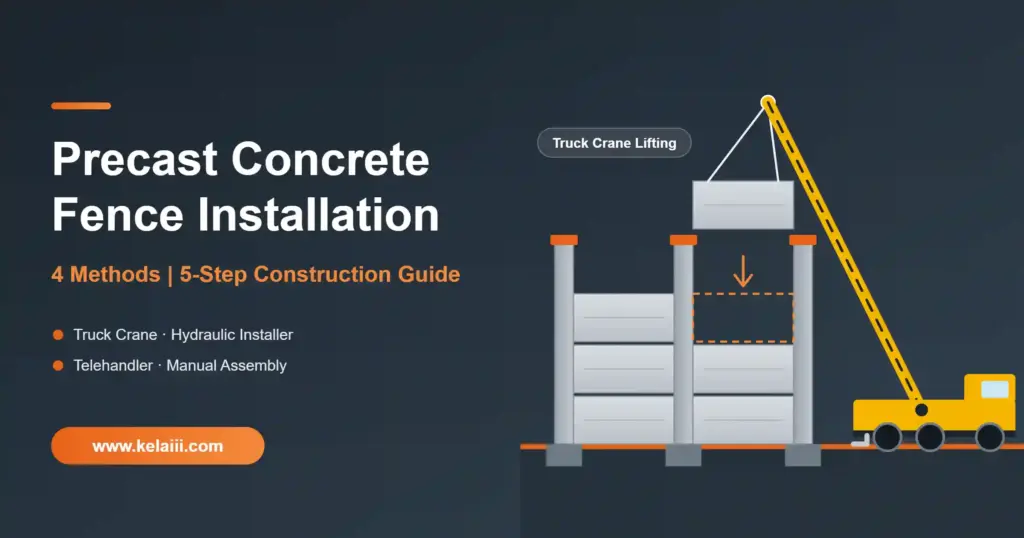
1. Truck Crane Lifting Method
The truck crane method suits large security projects: walls over 3 meters high, long continuous fence lines, or entire industrial parks and municipal boundaries.
Precast posts are anchored into the foundation first. A truck crane with specialized rigging then lifts each wall panel into the gap between posts. Workers fine-tune alignment and check the slots, verticality and joint gaps. The method is highly mechanized, needs little heavy manual carrying and works well for long continuous runs. It is generally much faster than traditional masonry, although actual gains depend on panel weight, haul distance, foundation progress and site access.
The method also demands accurate components. If panel thickness varies or the end slots deviate, you will see:
- panels that will not slide smoothly into the post slots;
- uneven joint gaps along the wall;
- walls that are hard to bring to vertical;
- longer hoisting times and idle crane hours.
Crane installation works best with standardized panels from a fully automatic wall panel production line or a hollow core slab extruder. Uniform panels need only minimal manual adjustment, which helps meet the precision and stability requirements of security boundary wall construction.
2. Hydraulic Wall Panel Installer Method
Some sites cannot take a heavy truck crane: urban renovation projects, narrow industrial parks, courtyard walls, or sites with restricted access roads. A hydraulic wall panel installer suits these constrained sites. It is compact and can lift, push the panel into the post slots and make fine adjustments, while workers check side clearances and verticality. It reduces the safety risk of manual lifting without needing a crane for every panel.
Ideal applications:
- confined sites where large cranes cannot enter;
- urban enclosures and brownfield or park renovation;
- private courtyards and villa boundary walls;
- small to medium precast wall projects;
- jobs that need frequent relocation of the installation position.
Hydraulic installers also depend on panel precision. Large deviations still mean repeated manual tweaking during insertion. Lightweight, high-precision modular panels from a precast concrete slab making machine have neat edges and uniform dimensions. They are less likely to jam, and joint gaps stay easy to control.
3. Telehandler-Assisted Installation Method
Telehandlers are widely used in overseas civil fencing and commercial site boundary work. They are easy to rent, cost less, and suit medium-weight fence elements 2 to 3 meters high. A wall panel clamp is fitted to the boom to position posts, lift panels and assemble the wall.
This approach needs a high degree of standardization. Panels and posts should come from multi-functional precast equipment and a precast fence post forming machine, so that sizes are consistent and parts are interchangeable. Little grinding or rework is needed on site, which is why this setup is a go-to workflow for local concrete fence contractors.
4. Manual Assembly Method (Small DIY & Temporary Enclosures)
For low temporary hoardings, small yard walls or simple isolation barriers, panels can be assembled by hand. This does not lower the requirements for the panels. They must be lightweight and dimensionally uniform. Panels from lightweight wall panel machines have controlled self-weight, smooth slots and precise dimensions, so two to three workers can carry them and insert them from the top down. No heavy machinery is needed, which suits small DIY projects and temporary boundaries.
| Method | Best For | Typical Wall Height | Site Access |
|---|---|---|---|
| Truck Crane | Large security & municipal projects | 3 m and above | Open, wide access |
| Hydraulic Installer | Narrow or urban sites | Small to medium | Restricted |
| Telehandler | Commercial & civil fencing | 2–3 m | Moderate |
| Manual Assembly | DIY & temporary enclosures | Low | Any |
How to Install a Precast Concrete Fence: 5-Step Construction Process
A standard construction process has five stages: foundation, post installation, panel assembly, joint reinforcement, and sealing and curing. Precise components at the start prevent misalignment, tilting and uneven gaps later.
Step 1: Site Survey & Precast Concrete Wall Foundation
Level the site, set out the axis lines and re-check elevations. Excavate post foundation pits at the designed spacing. Depth and sub-base should follow local geological conditions. On soft soil, lay and compact a crushed stone sub-base to prevent settlement. Foundation casting and curing quality directly affect the long-term stability and levelness of the wall. With a precast concrete wall footing, dimensions are more uniform and easier to match with precast components. Posts from an automatic production line have clean bases and minimal error, so they fit the foundation points seamlessly.
Step 2: Precast Fence Post Positioning & Fixing
Place the posts into the pits at their layout points. Use spirit levels and string lines to check verticality and post-to-post spacing, and keep all posts parallel and at the same top elevation. Backfill with poured concrete to lock them in, then let it cure until it reaches design strength before installing panels. Slot dimensions decide whether panels slide in smoothly. Posts made by a precast fence post forming machine have uniform slot depth, standard center distances and smooth inner walls, so panels slide in without jamming and joints are tighter.
Step 3: Precast Wall Panel Assembly (Core Stage)
Choose the installation machinery for the site. Insert each panel from the top down into the post slots and stack them layer by layer, checking levelness and verticality as you go. Cranes suit tall walls or heavy panels, hydraulic installers suit small to medium panels, and lightweight panels can be assembled by hand. Extrusion-based forming, using high-frequency vibration, gives smooth surfaces and tight tolerances, so little on-site grinding or patching is needed. Stable dimensions speed up installation and shorten the project schedule.
Step 4: Precast Wall Connection Details & Reinforcement
Seal and reinforce the gaps between panels and posts and the joints between panel courses. For higher security levels, add metal connectors or brackets. This step improves resistance to wind loads, seismic activity and water seepage. Uniform components give neat, even joints that need little mortar, so sealing is simpler and water is less likely to get in. That reduces weathering and loosening over time.
Step 5: Joint Sealing, Finishing & Curing
Clean off dust and debris, fill the joints with elastic sealant, and fit precast coping caps on top. Coping caps give a finished look and keep rainwater out. During curing, protect the wall from impact and shaking until it has fully stabilized.
Why Standardized Production Equipment Decides Fence Quality
Installation delays, oversized joint gaps, tilted walls and unstable structures look like site mistakes. In many cases the root cause is outdated component manufacturing equipment or an unstable production process. To make installation fast and free of rework, the factory needs a complete set of precast concrete wall panel production machinery.
1. Precast Wall Panel Extrusion Equipment
This is the main workhorse of a production line. A hollow core slab extruder uses automatic extrusion and vibration to mass-produce hollow-core and solid wall panels. The panels are dense, uniform in strength and accurate in size, so they work with every installation method above. For factories scaling up wall production, it is a core asset.
2. Precast Fence Post Forming Machine
This machine produces posts that match your panels. Its high molding precision keeps slot dimensions consistent, so panels and posts interlock cleanly. Many jamming and alignment problems are therefore removed at the factory.
3. Fully Automatic Precast Boundary Wall Production Line
An automated line combines material feeding, vibration, molding, demolding and curing in one continuous workflow. With high automation and low labor needs, it can run around the clock to supply standardized components in bulk. Explore our fully automatic precast boundary wall production line for large-scale projects. Controlling size and quality at the source lowers site difficulty, cuts trial adjustments and raises acceptance pass rates.
Precast Fence Equipment Procurement & Engineering Services
Good precast boundary wall projects need both scaled equipment production and standardized site installation. Professional precast fence manufacturers and installers offer one-stop services: component customization, equipment sales, construction scheme design and technical installation guidance. Whether you are upgrading an existing plant, buying machinery for a new project or looking for technical consulting, a reliable supplier can tailor the production line configuration and prepare a precast wall erection method statement for your project.
Learn more about our complete solutions at www.cnkelaiii.comveya contact our engineering team for a free consultation and a customized production line quote.
Planning a Precast Fence Project?
Get a customized machine configuration and technical guidance from our engineers.
Request a Free QuoteSık Sorulan Sorular
What is the fastest way to install precast concrete fence panels?
For long, large-scale fence lines, truck crane lifting is usually the fastest. For small or confined sites, a hydraulic wall panel installer or a telehandler is more practical.
Why do precast wall panels have uneven joints?
Uneven joints are usually caused by inconsistent panel thickness, irregular post slots or foundation errors. Using precision forming machinery in production prevents most of these problems.
What machines are needed to produce precast fence panels and posts?
A typical setup includes a hollow core slab extruder or wall panel extrusion machine, a precast fence post forming machine, and optionally a fully automatic boundary wall production line for large volumes.
Can precast concrete fences be installed manually?
Yes, for low or temporary fences. The panels must be lightweight and dimensionally uniform so that two to three workers can handle them safely.
Sonuç
Efficient precast concrete fence installation comes from pairing high-precision precast components with a matching installation method. Whether you use manual assembly, a hydraulic installer, a telehandler or a truck crane, component quality starts at the factory. Hollow core slab extruders, automated wall panel lines and post forming machines let you control precision at the source, which makes installation faster and the finished fence more reliable.