Casting on site means waiting on the weather, chasing crews, and cutting out the parts that failed inspection. Precast concrete machinery moves that work into a factory, where the same wall panel comes off the line the same way every day.
The idea is old. What has changed is the arithmetic. Labour costs in many of the markets we export to have climbed sharply since 2015, while a wall panel line now starts at around 800,000 RMB. More contractors are running those numbers and deciding to produce in-house.
This guide covers what precast concrete equipment does, what it costs, and how to tell whether one pays for itself in your situation. We build and sell this equipment, so read the figures with that in mind. Where a number depends on your local conditions, we say so instead of quoting a range that looks tidy and means nothing.
- Throughput per worker runs about 80% higher than site casting, though the exact figure moves with product mix
- The global precast market is growing around 8% a year; China is closer to 12% (2025 estimates)
- Most plants we supply recover their investment in 18 to 24 months
- The machine itself costs 0.6M to 2M RMB depending on type and capacity; budget 1.5M to 3.5M RMB for the first year all-in
- Factory production cuts waste by roughly 80% and lifts first-pass yield to about 96%
Table of Contents
ToggleWhat Is Precast Concrete Machinery?
Precast concrete machinery is the equipment used to cast structural concrete elements in a factory or yard rather than on the building site: wall panels, hollow-core slabs, floor and roof units, foundation beams, piles, architectural panels. The parts are made to size, cured, checked, and then trucked to site for assembly.
The reason for doing it this way is control. Site casting depends on the weather that week, the crew that turned up, and how carefully someone read the drawings. A factory line does not. Dimensions hold within a few millimetres, strength comes out where the mix design says it should, and you can forecast output a month ahead.
How a precast production cycle runs
- Mold preparation. Steel or composite molds are positioned and aligned to tolerance.
- Batching. Computer-controlled mixing from a concrete batching plant keeps the mix design consistent from cycle to cycle.
- Placement. Hydraulic filling with controlled vibration for consolidation.
- Curing. Steam chambers or chemical accelerators bring cycle time down from days to hours.
- Demolding. Finished units are lifted out mechanically.
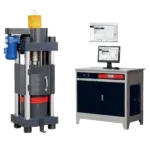
- Quality control. Dimensions and strength are checked, with a compression testing machine for strength, before anything leaves the yard.
- Delivery. Parts go to site and are craned into position, or set with a hydraulic wall panel installation machine for wall panels.
Steps 4 and 6 are where first-time buyers most often misjudge the work. Curing capacity usually limits output before the machine does, and quality control is a staffing commitment, not a checkbox.
Precast concrete vs site casting
| Factor | Precast | Site casting |
|---|---|---|
| Throughput per worker | About 80% higher | Baseline |
| Time to a finished unit | 4-8 hours | 7-14 days |
| Labour per unit | About 45% lower | Baseline |
| First-pass yield | 96% | 70% |
| Weather dependency | None | High |
| Waste | About one fifth of site volume | Baseline |
| Project programme | 30-45% shorter | Baseline |
| Cost per unit | 30-40% lower | Baseline |
Those ranges come from projects we have supplied and from Chinese industry data. A plant running one standard product at high utilisation will land near the top. A plant making bespoke stair and facade units will not, and no equipment supplier can change that for you.
The Four Main Types of Precast Concrete Machinery
Two mistakes come up repeatedly. Buyers size the line for the largest order they can imagine rather than the orders they have, and they buy a single-product machine because it was cheaper. Both show up in year three.
Type 1: Wall panel systems
Used for exterior walls, internal partitions, and load-bearing wall panels.
- Capacity
- 5,000-20,000 m² a year
- Cycle time
- 4-8 hours
- Panel size
- 3 m × 6 m up to 8 m × 12 m
- Tolerance
- ±5 mm
Output in practice
- Small plant: 8,000 m²/year (10-15 panels a day)
- Medium plant: 15,000 m²/year (20-25 panels a day)
- Large plant: 25,000 m²/year and up (40+ panels a day)
Best fit: housing manufacturers, commercial developers, large residential schemes.
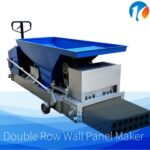
KELAI equipment for this: Precast Wall Panel Extruder Machine, Double Row Hollow Precast Wall Panel Machine, Concrete Wall Panel Cutter.
On KELAI China: Precast Concrete Wall Panel Extruder Machine, Precast Concrete Wall Panel Making Machine.
Type 2: Hollow-core slab extruders
Used for floor systems, roof slabs, parking decks, and long spans.
- Capacity
- 3,000-15,000 m² a year
- Slab thickness
- 150-400 mm
- Span
- Up to 25 m
- Extrusion speed
- 10-20 m an hour
Output in practice
- Small plant: 5,000 m²/year (15-20 slabs a day)
- Medium plant: 10,000 m²/year (30-40 slabs a day)
- Large plant: 20,000 m²/year and up (60+ slabs a day)
Best fit: multi-storey residential, office complexes, industrial buildings, highway and bridge work.
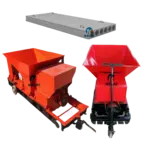
KELAI equipment for this: Concrete Hollow Core Slab Molding Machine, Precast Concrete Slab Extruder Machine, Prestressed Steel Wire Tensioning Machine.
On KELAI China: Concrete Hollow Core Slab Machine, Precast Concrete Slab Making Machine.
Type 3: Ground beam and foundation systems
Used for foundation beams, ground beams, and other structural elements that repeat across a project.
- Capacity
- 5,000-25,000 m³ a year
- Beam length
- 3-20 m
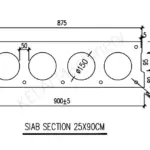
- Section profiles
- Several standard
- Tolerance
- ±10 mm
Output in practice
- Small plant: 3,000 m³/year (8-12 units a day)
- Medium plant: 8,000 m³/year (20-30 units a day)
- Large plant: 15,000 m³/year and up (40+ units a day)
Best fit: infrastructure and transport work, industrial complexes, large developments.
KELAI equipment for this: H Column Beam Extruder Machine, Precast T Beam Making Machine.
On KELAI China: Prestressed Concrete T Beam Machine, H Column Extruder Machine.
Type 4: Specialised lines
- Spun pile machines for high-strength foundation piles
- Beam and column systems for structural shapes
- Architectural panel systems for facade work
- Utility box systems for drainage and service conduits
KELAI equipment for this: U Shape Column Making Machine.
On KELAI China: Precast Concrete Pillar Machine.
Precast vs Site Casting: What Changes When Production Moves Indoors
A 100,000 m² commercial scheme, both ways
We supplied the equipment on a project of roughly this size, so the comparison below is drawn from a job we saw through rather than from a market report. One caveat: it is a repetitive scheme. Bespoke work will not produce these numbers.
| Measure | Casting on site | Using precast |
|---|---|---|
| Programme | 48 months | 32 months (33% shorter) |
| Site labour | 450 workers | 200 workers (56% fewer) |
| Defect rate | 8-12% | 4% |
| Waste | 80,000 tonnes | 16,000 tonnes (80% less) |
| Cost | 100M RMB (baseline) | 65-70M RMB (30-35% lower) |
The 33% programme saving sits at the low end of the 30-45% range we see. The top of that range belongs to schemes with a high degree of repetition, where the same panel appears hundreds of times.
Where the money goes in a year
Annual running cost for a plant at 10,000 m² a year:
| Cost category | Site casting | Precast | Difference |
|---|---|---|---|
| Direct labour | 2.4M RMB | 1.1M RMB | 1.3M lower (54%) |
| Waste handling | 800K RMB | 160K RMB | 640K lower (80%) |
| Rework | 600K RMB | 120K RMB | 480K lower (80%) |
| Weather delays | 500K RMB | 0 | 500K lower |
| Local transport | 300K RMB | 400K RMB | 100K higher |
| Equipment depreciation | 100K RMB | 600K RMB | 500K higher |
| Total | 4.7M RMB | 2.4M RMB | 2.3M lower (49%) |
What this table hides. The equipment is a fixed charge, whether it shows up as depreciation or as loan repayments, and you carry it whether the plant runs or not. The labour saving only materialises if you actually reduce headcount or take on more work with the same crew. Plants that buy a line and keep the same payroll get a much weaker result, and it is the most common reason a payback calculation misses.
What else changes
- Waste drops about 80%, because offcuts and over-ordering are controlled at the mold
- Site headcount falls by roughly half, which also reduces incidents
- Output no longer stops for rain or for a heat wave that shuts down pours
- Factory work is more stable than site work, which matters when you are trying to keep trained operators
- First-pass yield sits around 96% against roughly 70% on site
Precast Concrete Market Growth Through 2028
Size and growth (2025 estimates)
Global market: about $185 billion in 2025, growing roughly 8.2% a year to about $235 billion by 2028.
China: about $65 billion in 2025, growing 12% or more, well above the global average. That is around 35% of global precast demand.
Why China moves faster
- New construction exceeds 1 billion m² a year
- Policy favours industrialised building methods
- Labour cost inflation pushes mechanisation
- Large infrastructure programmes carry hard quality and schedule requirements
Precast market by region
| Region | Market size (2025) | Annual growth | Main drivers |
|---|---|---|---|
| China | $65B | 12%+ | Urbanisation, infrastructure |
| Europe | $45B | 6.5% | Carbon rules, labour costs |
| North America | $35B | 5.8% | Schedule pressure, standardisation |
| Southeast Asia | $20B | 9.5% | Construction boom |
| Other | $20B | 4.2% | Gradual adoption |
What is changing in the equipment
Automation is the obvious one: computer-controlled cycles, camera-based dimensional checks, live production reporting, and integration with project management software.
Two quieter shifts matter more to a buyer. Vendors are consolidating, so the company selling you a machine increasingly wants to sell you the whole yard design as well. And service is becoming the product, with site design, operator training, and ongoing support bundled in. Both are generally good for the buyer, provided you check what the bundle actually commits them to.
How to Choose Precast Concrete Equipment: Five Checks Before You Buy
1. Capacity against demand you can actually book
Size the line so that demand you can realistically book fills 85-95% of its capacity.
A contractor choosing between two lines:
- Option A: 15,000 m²/year, 1.2M RMB
- Option B: 25,000 m²/year, 1.6M RMB
If real demand is 12,000 m²/year, Option A runs at 80% and still makes money. Option B runs at 48%, and the extra 400,000 RMB buys idle steel. Undersized equipment costs you an opportunity. Oversized equipment costs you every month.
2. Total cost, not the price on the quote
Budget lines buyers forget:
- Yard preparation, 20-50K RMB: ground works, utilities, foundations
- Installation and commissioning, 5-10K RMB
- Molds and tooling, 15-30K RMB for your product range
- Operator training, 5-8K RMB per operator
- Working capital, 50-100K RMB for the first production cycles
- Annual running costs, 300-500K RMB: power, maintenance, consumables
First-year total:
- Small plant: 1.5-2.0M RMB
- Medium plant: 1.8-2.5M RMB
- Large plant: 2.5-3.5M RMB
The mold line is the one people skip. It is also the one that stops production in month two when you realise the second product needs its own set.
3. What happens when it breaks
Ask these before signing:
- How fast do you get a technician on site? Target 24-48 hours.
- Are common wear parts held in stock, or ordered from the factory?
- Is operator training certified, and how long does it run?
- Is there a preventive maintenance schedule? Quarterly visits is the usual standard.
- Can the machine be diagnosed remotely?
A line that is down for two weeks loses about 4% of a year's output. On the 12,000 m² plant in the worked example below, that is roughly 390 m² of panels. Service quality is not a soft factor. What KELAI covers is set out on our services page.
4. Room to change product
Product mixes shift, usually within three to five years. Check whether you can add capacity modules, whether molds and tooling can be reworked, whether the line handles a different component if demand moves, and what reconfiguration costs.
A wall panel line that cannot be adapted to hollow-core slab becomes a stranded asset the year your market turns. Flexible tooling costs more upfront. It is cheaper than buying a second machine.
5. Whether the manufacturer will still exist
- Ask for 5-10 customer contacts on similar projects, and call them
- How long has the manufacturer been operating? Ten years is a reasonable floor
- Are they financially stable enough to support the machine for 15 years?
- Are they still developing the product line, or selling the same machine they sold in 2016?
- Do they have service coverage where you operate?
A 1.5M RMB machine is worth very little if the manufacturer closes and nobody stocks the hydraulic pump.
Precast Equipment in Practice: Three Applications
These are composites drawn from projects we have supplied, not single named jobs. They show what the equipment does under different demand patterns.
Large commercial developer
500,000 m² mixed-use scheme, offices, retail, and residential. Wall panel plus hollow-core slab. Equipment spend 2.4M RMB.
- Programme: 48 months down to 32
- Site labour: 35% lower
- Cost: 120M RMB down to 82M
- First-pass yield: 92%, against 68% before
- 180,000 m² produced a year at high utilisation
- Payback in 14 months, faster than the 18-24 months most plants see
- Year two onward: about 5.8M RMB a year of margin improvement
Government housing programme
200,000 m² of affordable housing, 10,000 units. Wall panel plus ground beam systems. Equipment spend 1.8M RMB.
- Programme: 54 months down to 36
- First-pass yield: 97%, which mattered for the government acceptance standard
- Cost per unit: 450K RMB down to 320K
- Payback: 20 months
- Predictable contract volume makes financing easier to arrange
Highway viaduct
80,000 m³ of precast elements. Hollow-core slab plus spun pile systems. Equipment spend 2.1M RMB.
- Programme: 60 months down to 40
- Specification compliance: 98%
- Cost: 85M RMB down to 58M
- On-site incidents: 67% fewer
- Year one utilisation: 95%
- Payback: 16 months, helped by that high utilisation from the first year
How to Calculate Precast Equipment Payback
Payback (months) = total upfront investment ÷ monthly net improvementA worked example
A contractor buys a wall panel line for 1.2M RMB to supply 12,000 m² a year to one developer. Setup adds 150,000 RMB, so total upfront is 1.35M RMB.
Production cost per m² falls from 800 RMB to 600 RMB, a saving of 200 RMB. Running the plant adds about 500,000 RMB a year in power, maintenance, consumables, and one extra technician.
Year one, while the crew is learning and orders are still ramping, the plant runs at 45%:
- 5,400 m² × 200 RMB = 1.08M RMB gross
- Less 500,000 RMB of added fixed cost
- Net improvement: 580,000 RMB
That leaves 770,000 RMB to recover.
Year two, at 85%:
- 10,200 m² × 200 RMB = 2.04M RMB gross
- Less 500,000 RMB
- Net: 1.54M RMB, or about 128,000 RMB a month
- 770,000 ÷ 128,000 = 6 months
Payback lands at roughly 18 months.
Two things push it out. Year-one utilisation is often below 45% for a first-time operator, and most plants buy a second mold set in year two. Interest on a financed purchase adds more. Treat 18 months as a decent case rather than the expected one. If utilisation stalls near 60% and savings and setup costs also come in worse (the conservative column below), expect 30 months or more.
What moves the number
| Variable | Optimistic | Realistic | Conservative |
|---|---|---|---|
| Utilisation once running | 90% | 85% | 60% |
| Saving per m² | 240 RMB | 200 RMB | 160 RMB |
| Total upfront | 1.0M RMB | 1.35M RMB | 1.7M RMB |
| Payback | 10-14 months | 18-22 months | 30-36 months |
Utilisation dominates everything else on that list. A well-run plant with a mediocre machine beats a badly-loaded plant with an excellent one.
Precast Concrete Machinery: Frequently Asked Questions
How much factory space does a precast line need?
For a medium wall panel operation:
- Production area: 5,000-8,000 m² for molds, curing, and demolding
- Curing: 2,000-3,000 m² for steam chambers or accelerated curing zones
- Material storage: 1,000-2,000 m² for cement, aggregate, and rebar
- Finished goods yard: 2,000-3,000 m² outdoors
- Offices and quality lab: 500-800 m²
Total: roughly 10,500-16,800 m². A small plant at 8,000 m² a year can work in 8,000-10,000 m² if curing is shared. Above 25,000 m² a year you need 20,000-25,000 m², and the constraint is usually yard space for finished stock rather than the production hall.
Can one precast machine make several products?
Yes, with caveats. Changeover times:
- Wall panels: swap the mold, 2-4 hours
- Hollow-core slabs: change the extrusion die, 3-6 hours
- Bespoke shapes: new molds, one to two days
The economics are the limiting factor. Each product needs its own molds at 15-30K RMB a set. Running three or four products at once ties up capital in tooling and cuts batch sizes, so per-product efficiency falls. Standardise on two or three core products unless you are being paid a premium for variety.
How long does precast equipment last, and what does upkeep cost?
Service life is 15-20 years. Structural frames and hydraulic systems run 20 years or more with proper maintenance. Seals, dies, and electrical components need replacing every 5-10 years.
Annual maintenance as a share of the machine's purchase price:
- Years 1-5: 3-5%
- Years 6-10: 5-8%
- Years 11-15: 8-12%
- Year 15 onward: 10-15%, at which point replacement is usually the better call
On a 1.2M RMB line that is 36-60K RMB a year early on, 60-96K RMB in years 6-10, and 96-144K RMB in years 11-15. Deferred maintenance is the expensive option, because a failed hydraulic system takes the whole line down with it.
Do precast machine operators need specific training?
Yes. Precast machinery is not general construction equipment. Operators need to manage cure cycles and demolding, run dimensional and strength checks, handle preventive maintenance, and look after molds properly.
Training costs:
- Operator certification: 3-5 days, 5-8K RMB each
- Supervisor training: one week, 8-12K RMB
- Maintenance technician: two weeks, 12-18K RMB
A 12,000 m² a year plant runs with 4-6 operators, one full-time maintenance technician, and one supervisor or QC lead. Six to eight people in total. Skilled operators have a direct effect on output, and replacing one costs more than paying to keep them.
Is financing available for precast concrete equipment?
Generally yes. Common structures:
- Equipment loans: 5-7 years, 70-80% LTV, 5-7% interest
- Operating leases: monthly payments, vendor keeps ownership, upgrade options
- Sale-leaseback: buy the machine, lease it back to free up cash
- Government subsidies: some regions cover 10-30% of industrial modernisation spend
On a 1.2M RMB line with 20% down: 960,000 RMB financed over six years at 6% comes to about 15,900 RMB a month. Against the 128,000 RMB a month of net improvement in the example above, that leaves plenty of room. Lenders will want to see the same utilisation assumptions you are using.
Is a Precast Line Right for You?
The case for precast rests on four numbers: cost per unit 30-40% lower, throughput per worker about 80% higher, programmes 30-45% shorter, and first-pass yield around 96% instead of 70%. Whether those numbers apply to you depends less on the machine than on what you keep it busy with.
Before committing, check that:
- You can book 85-95% of the line's capacity
- The money is available, as equity or as financing
- You have, or can hire, people who will run and maintain it
- The supplier can support it where you operate
- Producing precast fits a five to ten year plan, not one project
If all five hold, the equipment pays for itself. If two of them do not, no specification sheet will save it.
Talk to an engineer about your line
Book an equipment consultationBrowse KELAI machine typesRead the precast machinery FAQ
For technical questions or custom requirements, our engineering team is at [email protected] or +86 17788171295 (also on WhatsApp). Our China site, KELAI China, lists the same range.